
How to Choose the Best Personal Trainer in Dubai: 10 Questions to Ask Before You Sign
Dubai has hundreds of personal trainers. Most are average, a few are excellent, and a handful will waste your time and money. This is the exact framework real clients use to find a coach who actually delivers — credentials, red flags, and 10 questions every great trainer will happily answer.
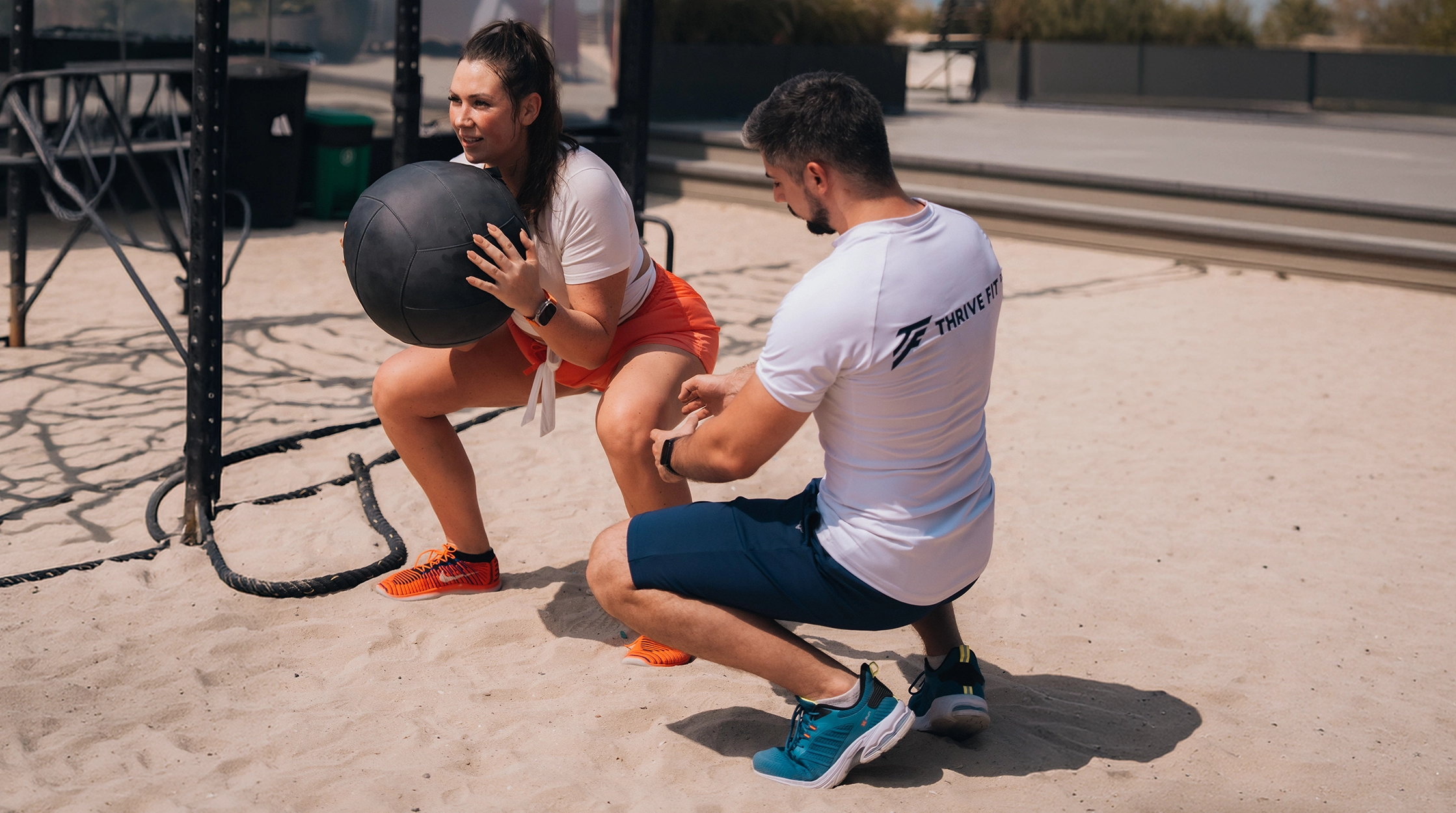
Searching for the best personal trainer in Dubai can feel like a marketing assault. Every coach claims elite results, 10 years of experience, and a "proven methodology." Cut through the noise with a structured decision process. This guide gives you the exact one our clients use — the same framework you'd apply before hiring any professional for a 12-week engagement that costs AED 10,000+.
01. Credentials That Actually Matter in Dubai
Dubai's personal training industry is regulated, but not strictly enforced. The real gatekeeping happens at the client level — and most clients don't know what to check for. Here's the hierarchy of credentials in 2026:
- REPs UAE (Register of Exercise Professionals) — the UAE's official personal trainer registry. Non-negotiable.
- International certification — NASM, NSCA-CPT, ACE, ACSM, or PTA Global. These are globally recognised and signal real education.
- Specialist certifications — Precision Nutrition for nutrition, FMS or NASM-CES for corrective exercise, NSCA-CSCS for strength & conditioning. Specialists command premium prices because they solve specialist problems.
- University degree — a BSc in Exercise Science, Sports Science, or Physiotherapy is a big trust signal, especially for rehab or performance work.
A "certified personal trainer" with no REPs UAE number is not operating legitimately in Dubai. If the coach dodges the question or waves it off, that's your answer.
02. Experience vs. Specialisation — Which Matters More?
A coach with 10 years of general experience and a coach with 3 years of specialisation in your specific goal can both be excellent. The wrong fit is a 10-year generalist for a specialist problem — say, a postnatal recovery client with diastasis recti working with a bodybuilding-focused coach.
Match your goal to the coach:
- Fat loss + general fitness: 5+ years general experience is fine.
- Strength & performance: look for NSCA-CSCS or powerlifting/sports coaching background.
- Body transformation / photo-ready physique: ask for before/after portfolio of similar body types.
- Injury rehab or chronic pain: NASM-CES, FMS Level 2, or a physiotherapy-adjacent background.
- Pre & post-natal: PN certified with specific postpartum training — this is not a generalist job.
- Kids & youth: IYCA or NSCA youth specialist. Kids aren't small adults.
03. The 10 Questions That Reveal Everything
Use this exact list on your free intake call. Great coaches love these questions. Bad coaches get defensive. Silence is information.
Question 1. "What's your REPs UAE number and your lead international certification?"
Both should come without hesitation. "I'm working on REPs" is a no.
Question 2. "Can I see three client transformations that match my starting point?"
Not their best-ever. Matching yours. Someone who started at your body fat %, your age, your schedule, your injury history.
Question 3. "Walk me through the first 4 weeks if I sign today."
A real coach answers in plain English: intake → movement screen → baseline testing → foundational phase → progression to strength/hypertrophy/conditioning based on goal. A bad coach says "it depends" and changes the subject to pricing.
Question 4. "How do you handle a week where I travel or miss sessions?"
The right answer involves a travel programme, a hotel-gym version of your workout, and session rollover policy in writing. Not "we'll figure it out."
Question 5. "What's your approach to nutrition?"
Ideal answer: habit-based targets first (protein, fibre, hydration, sleep), then macros if goals require it, no extreme cutting, full transparency on what's in and out of scope vs. a registered dietitian.
Question 6. "Do I get a written programme, or do you make it up session-by-session?"
Both can work. What you want is intentional. Pure freestyling on day one is a red flag; rigid month-4 programme printed on day one is another red flag.
Question 7. "How do we measure progress, and how often?"
Great coaches use multiple signals: bodyweight trend, InBody or circumference, strength benchmarks, conditioning benchmarks, photos, and subjective markers (sleep, energy, mood). Single-metric coaches (scale only) miss the full picture.
Question 8. "What happens if I'm not progressing after 6 weeks?"
The right answer is "we review training, nutrition, sleep, stress, and step count, identify the bottleneck, and change one variable at a time." If there's no plan for non-linear progress, you're getting a template.
Question 9. "What's your cancellation and refund policy?"
Look for: 24-hour cancellation without penalty, pro-rated refund on unused sessions, no aggressive auto-renewal. If the contract punishes you for life changes, walk.
Question 10. "Who else would you recommend if we're not a fit?"
This is the ultimate honesty test. A great Dubai coach knows three or four other excellent coaches and refers happily when the fit isn't right. A coach who claims to be the only option is selling.
04. Red Flags That Should End the Conversation
Stop the conversation if the coach:
- Can't produce a REPs UAE number.
- Pressures you to sign a 36-session package on day one.
- Promises a specific kg loss number in a specific timeframe ("I'll get you -15kg in 8 weeks, guaranteed").
- Has zero before/after portfolio after "10+ years of experience."
- Claims to "specialise" in fat loss, strength, rehab, nutrition, pre-natal, post-natal, kids, and seniors simultaneously.
- Insists on extreme caloric deficits (below 1,200 kcal for women, below 1,500 kcal for men) without a medical reason.
- Gets evasive about training location, session length, or what's included.
- Refuses a trial session.
- Doesn't ask about injury history, sleep, or stress during the intake.
- Badmouths other coaches in Dubai as a sales tactic.
"In 12+ years of coaching between Europe and Dubai, the best predictor of client success isn't the coach's CV. It's the honesty of the first conversation. If the intake feels like a sales pitch, the programme will feel like one too. Find the coach who asks more questions than you do."
05. Male vs. Female Personal Trainer in Dubai — Does It Matter?
For most clients, coaching quality beats gender every time. The right coach is the one with the right experience and methodology for your goal. But Dubai has specific contexts where gender preference is entirely valid:
- Modesty or cultural comfort: many female clients in the UAE prefer a female personal trainer in Dubai for in-home sessions, and that's fine.
- Pre and post-natal work: female coaches with lived experience often communicate the emotional side better.
- Locker-room / gym comfort: same-gender coaches simplify gym-based sessions.
Outside those cases, choose on methodology and experience.
06. Choose for Your Location, Not the Coach's
One of the most overlooked factors when picking the best personal trainer in Dubai: logistics. If your coach is based in Dubai Marina and you live in Arabian Ranches, you'll either pay a location premium, compromise on session frequency, or burn out from the traffic.
Match your location to their coverage:
- Downtown / Business Bay / DIFC: virtually every major Dubai coach services this zone.
- Dubai Marina / JBR / Palm: coastal coaches are easier to book, but peak-hour traffic makes afternoon sessions tough.
- Arabian Ranches / Dubai Hills / Al Barari: look for coaches based in Al Quoz or Al Barsha — central to your area.
- Mirdif / Al Warqaa: fewer coach options; consider morning sessions to avoid traffic.
- JVC / JVT / Motor City: growing coverage — most ThriveFit DXB coaches cover this zone.
07. The Trial Session — What to Actually Evaluate
Don't just judge the coach on how hard they make you work. A trial session tests five specific things:
Trial session evaluation checklist:
- Warm-up quality: did they screen your movement or skip straight to exercises?
- Cueing: did their corrections actually help you feel the lift differently?
- Rest periods: are they structured, or are they on their phone?
- Intensity calibration: did they read your body and adjust — or push you through bad reps?
- Debrief: did they send a summary of what you did and what's next?
08. Is ThriveFit DXB the Right Fit for You?
We're not the best fit for everyone, and we'll tell you so on the intake call. ThriveFit DXB is built for:
- Busy Dubai professionals who need in-home personal training because traffic kills their consistency.
- Clients targeting a real 12-week body transformation with structured programming and nutrition.
- Expats returning to training after a 2+ year break who need technique rebuilt before loading weight.
- Corporate teams wanting group performance programmes.
- Families wanting coached children's fitness built around growth and movement quality.
If your goal is competitive powerlifting, competitive physique prep for stage, or elite sport-specific performance, we'll refer you to a specialist. That honesty is the point.
Frequently Asked Questions — Best Personal Trainer in Dubai
Ready for an honest intake call?
No sales pressure. No 36-session upsell. Just a real conversation about your goal, schedule, and whether we're the right fit. Takes 20 minutes.